

Current Exhibition
𝘛𝘩𝘦 𝘚𝘢𝘤𝘳𝘦𝘥 𝘝𝘰𝘪𝘥
YANG Zong-Jia
Duration
2025.9.20 - 10.26
“𝘛𝘩𝘦 𝘚𝘢𝘤𝘳𝘦𝘥 𝘝𝘰𝘪𝘥” evokes an invisible, near-illusory state—where, even within the fog and veils of the human heart, the light of the self may still be found. Here, the notion of the “Saint” becomes a symbol of divine guidance, a signpost pointing toward transcendence. Through his pursuit of faith, Yang Zong-Jia seeks to shape an image that belongs solely to himself, while posing a profound question: If one could define oneself as divine, then what, truly, is redemption?
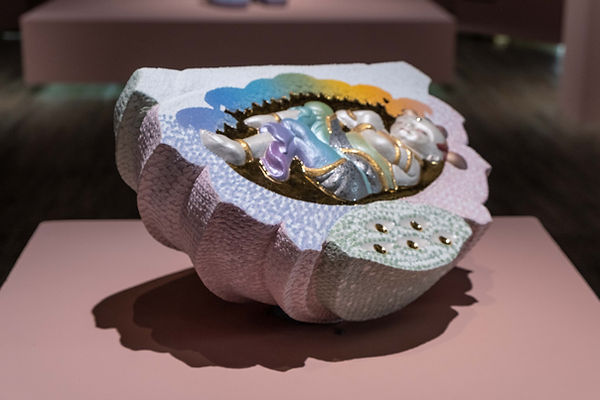
The core medium of this exhibition is the “mold.” Traditionally, the concave mold serves as the “mother mold,” used for replication and mass production, while the convex mold is the object being reproduced. The artist subverts this convention by reversing the process—casting the negative from the convex mold, then hand-shaping with coiled ceramic strips. In doing so, the works invite reading from multiple perspectives, revealing a sculptural presence that is at once beguiling and uncanny.

YANG Zong-Jia
Born in Taiwan in 1992, Yang Zong-Jia graduated from the Department of Material Arts and Design and the Graduate Institute of Applied Arts at Tainan National University of the Arts. Working primarily with ceramics, often in combination with fiber and assemblage, his practice has been widely exhibited in Taiwan and internationally. Yang has received major honors including the Gold Medal in Sculpture at the 9th National Art Exhibition, First Prize at the 6th Tainan New Art Award, and First Prize at the 3rd Taiwan Youth Ceramic Award. His works are held in the collections of institutions such as the Herng Ching Cultural and Educational Foundation, Chia-Yang Foundation, University of Arkansas, Shanghai Arts & Crafts Vocational College, Flower City Arts Center, and the Global Strategic Investment Fund.


Statement
In folk belief, the search for the divine is a journey outward in pursuit of redemption. Yet in The Sacred Void, Yang Zong-Jia turns this search inward, exploring the tension between faith and self. His works question the boundaries between divinity and humanity, light and shadow, salvation and illusion.
Departing from traditional sculptural conventions, Yang employs molds in reverse—casting negatives from positives, then hand-shaping with coiled ceramics. This process produces forms that can be read from multiple angles, their presence both beguiling and uncanny. By juxtaposing intaglio and relief, the works reveal the dual faces of belief: the sacred that uplifts, and the sacred that binds. In this space of paradox, Yang seeks a light of his own within the void.


